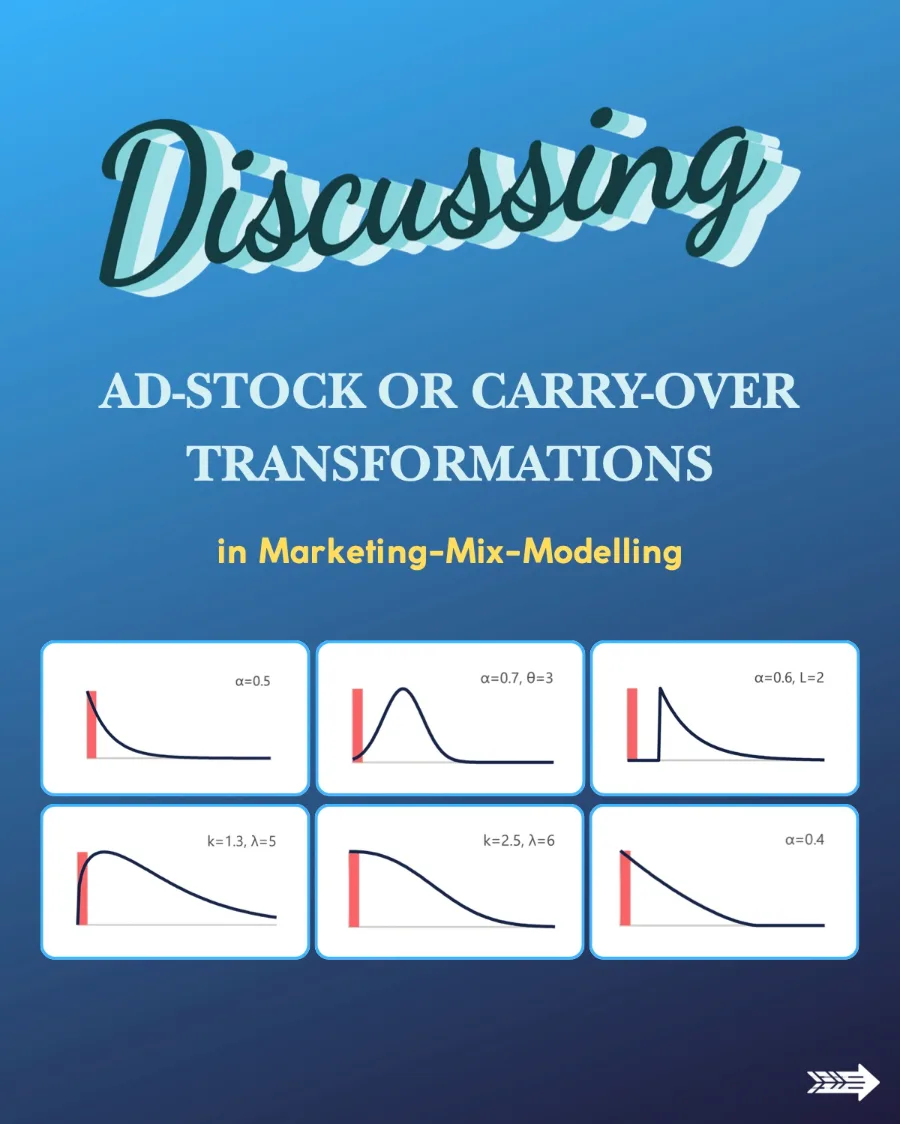
Marketing communication very often has an effect not only in the period in which it is on air, for example the week of a TV flight, but also in the following periods. In other words, it shows not only a short-term but also a mid-term effect. This is referred to as the ad-stock or carry-over effect.
Why ad-stock matters
The size of the carry-over effect significantly impacts the return on investment of an activity. If you ignore it, you undervalue activities whose effect builds up or lasts over several weeks. Ad-stock is therefore a key result of every marketing mix modelling project and an important planning insight.
- No ad-stock: the effect occurs only in the period of airing, with no effect in the following periods.
- Geometric ad-stock: the main effect occurs in the period of airing, with a declining effect in the following periods.

Different ad-stock types for different activities
There is no one-size-fits-all approach. Ideally, the ad-stock type fits the underlying activity and the market environment. These are the six most common transformations, where l is the lag in periods and w the weight of the effect:

Geometric
Formula: w ∝ αl, decay α ∈ [0, 1]. Peak at the start, followed by an exponential tail.
Delayed geometric
Formula: w ∝ α(l − θ)², decay α, delay θ. The peak occurs θ periods after the activity.

Lagged geometric
Formula: w = 0 for l < L, then ∝ αl − L, decay α, lag L. No effect for L periods, then geometric decay.
Weibull PDF
Weights follow the Weibull density with shape k and scale λ, rescaled so that the peak weight equals 1. Very flexible: the effect can rise and then fall. With k < 1 the decay is immediate, k = 1 reduces to geometric decay, and k > 1 pushes the peak away from period zero. This captures a delayed build-up, such as a brand campaign that peaks two or three weeks after airing.

Weibull CDF
Weights are the running product of the Weibull survival function. Unlike the geometric family, the retention rate per period changes with the lag. The result always decreases, but the decay can accelerate (k > 1) or decelerate (k < 1) over time. With k = 1 it reduces to geometric ad-stock.
Binomial
Formula: w ∝ (1 − l / Lmax)1/α − 1, α ∈ [0, 1]. A finite window; α = 1 gives a flat window.


Not every engine supports every transformation
The choice of modelling engine limits which carry-over shapes you can test. Among the leading open-source engines, Meridian offers geometric and binomial ad-stock, Robyn offers geometric and Weibull PDF/CDF, and PyMC-Marketing supports all six. MMM Labs brings these engines together, so you can test the right ad-stock for each activity.

Want to know more?
We help brands and agencies choose, build and run the right measurement approach. Let’s talk about your questions in a 30-minute call.